Image

Explore how OTC CGM access with Stelo may create new opportunities for patient engagement and self-management.
This resource is intended for educational purposes only for healthcare providers practicing in the United States. It does not constitute medical advice and is not a substitute for professional judgment or individualized patient care.
As access to continuous glucose monitoring expands, clinicians are increasingly encountering patients who want to understand how glucose patterns relate to daily health behaviors. In this Q&A, endocrinologist Dr. Helen Baron shares practical insights on CGM adoption, patient engagement, and what clinicians should know about Stelo as over‑the‑counter glucose sensing becomes more widely available.
In this article, Dr. Helen Baron, Director of Diabetes Health Services at Eisenhower Medical Center and a globally recognized endocrinologist, explores what clinicians should know about Stelo and the emerging role of glucose insights in patient care. Drawing from decades of experience in endocrinology, diabetes management, and physician education, Dr. Baron shares practical perspectives on expanding awareness of glucose data, supporting patient engagement, and helping clinicians navigate this evolving area of metabolic health.

CGMs provide insight into glucose patters throughout daily life.
In my clinical practice, continuous glucose monitoring has fundamentally changed the way I communicate with my patients about glucose and their overall metabolic health.
Historically, much of diabetes care has been based on snapshots. We would obtain a laboratory fasting glucose value, an HbA1C, or ask patients to perform intermittent fingerstick. Those measurements remain extremely valuable, but they don't necessarily show us the glucose patterns occurring throughout an individual's daily life. CGM provides additional information—including mean glucose, time in range, time above and below range, and glucose variability—that serve to complement and enhance A1C and traditional blood glucose monitoring.1,2
Instead of informing a patient, “Your glucose is elevated,” I can sit down with that individual and ask, “What happened here?” We can look together at what occurred after breakfast, after dinner, overnight, after exercise, or during a particularly stressful day. Suddenly, glucose becomes connected to the patient’s actual life.
One of the most striking things I've observed is that this changes the nature of the conversation. It becomes much less about me telling patients what they should do and much more about patients discovering how their own bodies respond to their environment.
For example, a patient may believe their breakfast is healthy because they have eaten it for years. Then they see a reproducible glucose rise after that “healthy” meal. We can discuss the composition of the meal and perhaps experiment with changing the carbohydrate portion, increasing their dietary protein or fiber, or adding physical activity after the meal. Now the individual can observe their response to that change in real time without assumptions or guesswork. Glucose monitoring can be particularly useful when it is integrated with education about nutrition, physical activity, medication, and other aspects of diabetes self‑management.1
This produces metabolic knowledge. And knowledge is power.
When I teach other physicians about CGM, I emphasize that the value isn’t simply having more glucose measurements. The value is transforming glucose data into information that is meaningful to the individual and actionable within their life. Current ADA guidance similarly emphasizes that CGM should be coupled with education about utilization and interpretation of the data.1
Absolutely. In many patients, the change in engagement can be remarkable.
As clinicians, we’ve spent decades telling people that nutrition, physical activity, sleep, stress, and medication adherence matter. The challenge is that many of the physiologic consequences of those behaviors are invisible to the patient. CGM makes one essential component of that physiology visible.
A patient can eat a meal and see what happens to their glucose. They can take a walk after dinner and compare that response with a day when they remained sedentary. They may begin noticing differences associated with exercise, meal composition, meal timing, illness, stress, or other aspects of their daily lives. CGM is increasingly being studied not simply as a glucose‑monitoring technology but also as a potential tool for facilitating behavioral awareness and lifestyle modification.1,3
One of the most striking things I've observed is what happens when patients begin asking me the questions.
Instead of my saying, “I want you to exercise after dinner,” the patient comes into the office and says, “I noticed something. On the nights when I walk after dinner, my glucose pattern looks different. Why is that?”
That’s a very different clinical conversation because curiosity has replaced generalized instruction.
I think we sometimes underestimate the importance of that transition. Sustainable behavior change is difficult when patients are simply following a list of instructions. It can become much more meaningful when they are conducting small experiments in their own lives and seeing the results.
There’s emerging evidence supporting this broader role for CGM. A 2025 systematic review and meta‑analysis of 21 trials involving 1,488 adults found changes in some dietary behaviors among CGM users, although improvements were not demonstrated across all dietary and physical activity outcomes.3 This distinction is important: wearing a CGM does not automatically produce behavior change. The information becomes most valuable when patients understand how to interpret it and translate it into appropriate action.
At the same time, clinicians have an important role in helping patients interpret what they see. Not every glucose excursion is pathological, and an isolated rise in glucose should not automatically be labeled a “bad” food or a sign of disease. We want patients looking for patterns, not becoming anxious about individual numbers.
For me, the goal isn’t glucose perfection. The goal is glucose understanding.

CGMs can help patients conduct small experiments in daily life and see the results.
What excites me most about Stelo is the opportunity to expand access to glucose information beyond the populations that have traditionally used CGM.
For years, CGM was largely thought of as a technology for people with diabetes—particularly people using insulin. That paradigm is changing. Current ADA Standards recognize OTC CGM as a distinct category of glucose‑sensing technology and specifically identify Stelo as an OTC CGM.1
Stelo’s availability without a prescription creates an opportunity for appropriate adults who are not using insulin to access continuous glucose information without first navigating the traditional prescription pathway.4
What I find particularly interesting is the opportunity to improve what I’d call glucose literacy.
Most people know their cholesterol. Many know their blood pressure. They may know their weight or their A1C. But relatively few people understand how dynamic glucose physiology actually is throughout the day.

That ability to connect glucose information with daily behaviors is one of the most interesting opportunities created by broader access to CGM. Current ADA guidance notes that OTC CGM may be used by people with prediabetes or without diabetes who wish to assess glycemic responses to lifestyle factors such as food choices and exercise.1
Importantly, however, CGM should not currently be viewed as a diagnostic test for prediabetes or diabetes. The 2026 ADA Standards specifically state that there is insufficient evidence to support CGM for screening or diagnosis of either condition.5
For me, that distinction is essential. CGM can generate awareness and questions; appropriate clinical testing establishes a diagnosis.
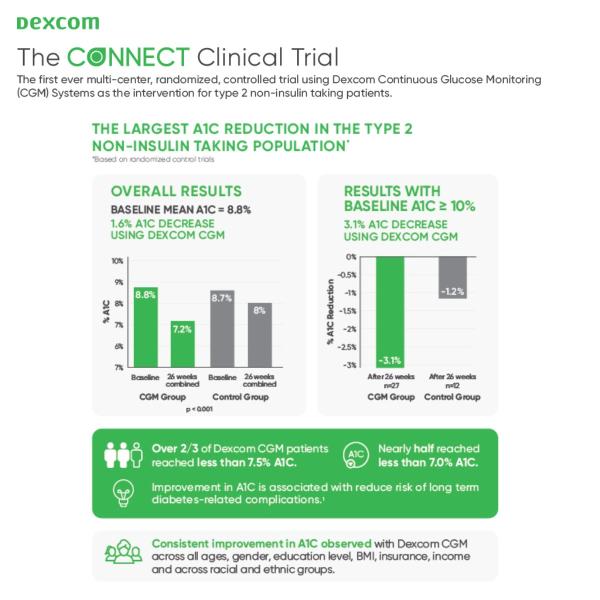
For adults with type 2 diabetes who are not using insulin, the evidence base is also becoming increasingly compelling. A 2025 systematic review and meta‑analysis of eight randomized trials involving 541 participants found that CGM was associated with an approximately 0.37 percentage‑point reduction in A1C, an 8.84 percentage‑point increase in time in range, and an 8.14 percentage‑point reduction in time above range compared with blood glucose monitoring or usual care.6
For me, that represents a broader evolution in metabolic medicine: moving from episodic health information toward longitudinal information. Instead of seeing a patient every three or six months and asking, “What have you been doing?”, we increasingly have the potential to discuss patterns generated during the patient’s actual daily life.
This helps create a much richer conversation between my patients and me.
I use CGM across a spectrum of patients, and the clinical question differs depending on who’s wearing it.
For someone with type 1 diabetes or insulin‑treated type 2 diabetes, CGM may be integral to day‑to‑day diabetes management. Current ADA recommendations support CGM for adults with diabetes using insulin, those using noninsulin therapies that can cause hypoglycemia, and individuals receiving other diabetes treatments when CGM helps with management.1,7
In other individuals with type 2 diabetes, CGM can help us understand postprandial glucose, overnight patterns, variability, and the effects of medication and lifestyle interventions. Evidence supporting CGM in people with type 2 diabetes who do not use insulin has expanded substantially, with randomized trials demonstrating improvements in A1C, time in range, and time above range.1,6
But I’m increasingly interested in another application: using glucose information to facilitate education and behavioral awareness in appropriate individuals who aren’t using insulin. One of the biggest misconceptions I encounter is that CGM is only useful if someone is taking insulin.
When I teach other physicians about CGM, I often ask them to think beyond the device itself. The question isn't simply, “Does this patient need a CGM to dose insulin?” Another question can be, “Would seeing their glucose patterns help this individual better understand their metabolic health or diabetes management?”
There are also misconceptions in the opposite direction, and this is equally important. More data is not automatically better data.
A person can look at a single glucose rise and conclude that a particular food is harmful. They can become overly focused on keeping the glucose trace perfectly flat. But human glucose physiology is dynamic. Glucose normally changes in response to food and other physiologic factors.
The clinical objective should not be to eliminate every glucose excursion.
Instead, we should teach patients to understand patterns, magnitude, duration, context, and reproducibility—and, when appropriate, to interpret those patterns alongside established clinical measures such as fasting plasma glucose and A1C.2,5
There are practical barriers as well: cost, access, comfort with technology, information overload, and clinician uncertainty about how to interpret large volumes of glucose data efficiently. The ADA also recognizes that the complexity and rapid evolution of diabetes technology can itself create implementation challenges for patients, caregivers, and health care teams.1
The technology gives us data. Our job as clinicians is to help patients translate this data into understanding.

Starting CGM early in the diabetes diagnosis provides both individuals and PCPs with a tool to guide decision making, measure progress, and increase patient self-efficacy.
I see barriers on both sides, but they’re different.
For patients, the biggest challenge is often interpretation. Once you give someone continuous access to a biological signal, it is very easy for individual numbers to take on more significance than they deserve. Patients may ask, “Is 145 bad?” or “Why did my glucose go up when I didn't eat?” Those are understandable questions, but they also illustrate why glucose needs context.
One of the things I emphasize with patients is: don’t chase every number—look for patterns.
The clinician barrier is somewhat different. Many healthcare professionals were trained in an era when glucose management meant fasting glucose, A1C, and perhaps a written log of fingerstick measurements. CGM produces an entirely different type of information. Standardized CGM reporting and metrics such as mean glucose, time in range, time above range, time below range, and glucose variability now allow clinicians to evaluate glucose patterns in ways that complement traditional measures.1,2
When I teach other physicians about CGM, I emphasize that they don't necessarily need to analyze every glucose value. We need to teach clinicians how to rapidly recognize the patterns that matter and how to translate those patterns into a useful conversation.
There can also be a conceptual barrier. If we continue thinking of CGM exclusively as an intensive diabetes‑management tool, we may overlook its potential role as an educational and engagement tool for other appropriate populations.
That is why I think OTC glucose sensing is so interesting. It potentially shifts some glucose discovery from the physician’s office into everyday life. The individual is generating information while eating, sleeping, exercising, working, traveling, and experiencing stress. Digital tools can then help organize that information into patterns. Stelo data can also be integrated with Dexcom Clarity, allowing clinicians to review glucose trends when patients choose to share their data.8
I don't see that as replacing the clinician. I see it as potentially making the clinician‑patient interaction more informed.
Ultimately, the opportunity that excites me most about glucose data is the possibility of moving metabolic health upstream—from reacting to disease toward helping people understand their physiology earlier and participate more actively in their health.
I’ve spent much of my career treating diabetes after it develops and working very hard to prevent, or at least delay, its complications. If glucose technology can also help appropriate individuals recognize meaningful patterns, understand the impact of their behaviors, and have more informed conversations with their healthcare professionals, that represents an important expansion of what CGM can contribute to metabolic health.
For me, the future of CGM isn't simply about measuring more glucose. It's about turning glucose data into awareness, awareness into understanding, and understanding into meaningful action.
Dr. Helen Baron is a world- renowned endocrinologist, researcher, and educator. As Director of Diabetes Health Services at Eisenhower Medical Center and a former USC professor, she trains physicians worldwide and is a frequent speaker at national and international medical conferences. Browse additional resources by this contributor and read her full bio.